Wap developers, would enjoy this link from Zytrax
It contains relations of all headers of User-Agent from every browser which comes with mobile model. I discovered it looking for mobile user-agent at Google.
Also, posted a correction for N80 phones.
"Nokia
For those of you working on Nokia web development Zoltan Szentesi has provided this link which provides information on features supported by a range of devices - thanks. And more - is there no limit to the generosity of mankind - a list of browsers ids for the n80 range - kindly provided by Luis Albinati - thanks.
NokiaN80-3/1.0552.0.7Series60/3.0Profile/
MIDP-2.0Configuration/CLDC-1.1
Explanation: Stock n80 string (see Nokia heading note for full list). String from Luis Albinati - thanks."
26 de set. de 2006


Pense como um Hacker!
Taí um passatempo legal pra quem gosta de charadas...
http://www.quizes.com.br/hacker/1
Do original: "FreeStuffHotDeals Hacker Puzzle!"
http://www.quizes.com.br/hacker/1
Do original: "FreeStuffHotDeals Hacker Puzzle!"
17 de set. de 2006
World Community Grid
Did you know you can help fighting AIDS, CANCER and more, from your home/work? I've discovered this few time ago at IBM. It's really an eletronic donative which no costs, as you just share your idle processing tasks :-)
World Community Grid is a project created by IBM for supporting tests using grid computing. Your computer processor makes all those mathematics calcs instead just one powerful computer. As results, data are fasten processed. You can participate:
-- Fight AIDS@HOME
-- Help Defeat Cancer
-- Human Proteome Folding - Phase 2
You can learn more visiting the site.
12 de set. de 2006
It's all about IT?
I'm not so old but, in the past there was only few of us: web/script programmers whose by the way must remember Html beginning, browse war between Netscape and Microsoft, DHTML, using Javascript and XML also (does isn't call AJAX now? ;-), PHP neurotics and Apatcher's ;-)
A world of lot of companies thinking about their business on the web, lot of portals, providers, but also a world of Trojan, broadcast mail viruses, of Windows 95 and its bugs...
Lot of this has been changed. Others have not.
Anyway, our business is going through a massive process to create patterns and standards which has good and bad things. Market vicious of PMI, CMM, RUP and other standards has been used very well in big companies such as IBM, TATA and others, but small/medium and companies which have a different business model, are carried into this trend in a wrong way by their entrepreneurs, which makes it bureaucratic, stalled and out of its reality.
We're still in a learn path of processes, and the good sense is on highest way for your T.I business. Massive models such as fordism have been used since the second global war and are considered mature now, but had passed by a lot of changes and adaptations. Models as ISO by example, becomes reliable companies and their large-scale products. There's now massive software production in large-scale been offered all the time. As in the past, market need control and standards for massive production, and UML, CMM, RUP models and others become true.
In the same way in manufacture model, small companies cannot compete against big companies in the same way. They need to be creative, dynamic and flexible - need to make it business fast, or it will no longer exists. Looking into this side, small an big companies have the same business in different ways. Each of them has their own responsability to check it out. My fast-overview:
What 'd changed:
Network changed from Dial up and point to point to High Speed Data Networks and peer-to-peer
Users has changed from telephony to instant messengers/talks
Email is not a feature, but a requirement
Searching changes the matters from real things to content
What is changing in Network
Television - HDTV, DVB, DVB-H
Mobility - UMTS/WCDMA
Last mile - WiMax/WiFi/Bluetooth
What is changing in Services
Relationship networks (for employments, jobs and social)
Mobility - Push, mobile banking, security, payments
Presence - connect everywhere (SIP/Jabber/etc)
Of course there is a lot of brand new things that are being developed or just wonder. The thing that still matters is not what, but how bring it all to our business.
6 de set. de 2006
Manhattan Story Mashup

"Manhattan Story Mashup is an urban game, taking place on September 23rd 2006 in Manhattan, New York City. During the event, approximately 250 players will move around Manhattan, taking photos which match a given target. Targets are words from stories, written by you and other visitors on this web site collaboratively while the game goes on. The resulting illustrated stories are shown on large public signs in Times Square in real-time and on this web site."
(from: http://www.storymashup.org/)
It will be happening on Saturday 23rd September 2006.
Watch the video!
Official web-site
5 de set. de 2006
Bluetooth matters
I'm trying to answer some questions about things that you can do with Bluetooth and Java, and things that you cannot yet. I won't write it at all, but on demmand ;-)
Bluetooth is still a child and I'll try to make an abstract of some definitions. I expect that it be useful...
What is Bluetooth?
Bluetooth is a technology based in profiles using radio communication in free band for short ranges. It uses IMS band (~2,4GHz), frequency hope time multiplexed.
Learn more at:
Bluetooth.org
java.sun.com
What is profiles?
Profiles are protocols-based, but a definitely implementation of them for a specified resource. For example, Audio Profile performs a standart for audio communication (using a defined protocol), which allows that any device that follow Bluetooth (.org) spec, can communicate each other.
Learn more at:
Bluetooth.org
What is the protocols stack?
The protocols stack is the high level layers which allow profiles working and application specific development. It means, when more high level protocol you've been using, more specific is your application and you have less flexibility in development (also it uses to be more hardly to develop as well). At the same time, while lower layer protocols you are, more flexible is your development, but it uses to be easier to.
Learn more at:
java.sun
What is the difference between master and slave? Is the same as server and client?
Not necessarily. Master is "who performs the connection" (keep that in mind). So, at typical topology of client/servers, server offers a service to the client, which connects to this. On Bluetooth, the slave offers the service to the master, which performs the connection and can be considered the "server" of the estabilished connection.
*#1 I've seen some trouble about it in Sun's website and also Nokia. I do prefer to follow Bluetooth (.org) spec.
*#2 Typical applications using Bluetooth are point to point. So, it really doesn't matter who is the client and who is the server. But for multi-point connections (PANs) will see that it does matter.
Learn more (really good - but you don't found it by navigation in Forum Nokia):
Forum Nokia
What is PAN?
The Personal Area Network is a profile created for enabling multi-point connection between devices whose support this profile, enabling ad-hoc networking. There's two types of networks for this, the Piconets and Scatternets.
**Can I do with Java for limited devices (J2ME/CLDC)?
Theoretically yes. But in the practice, limited devices don't need to implement this profile and it really consumes memory and processor which is very expensive for these devices. Bluetooth API for Java does not enable ad-hoc (JSR-82). For this, must watch the JSR-256 (AD-HOC API) which purposes is to enable ad-hoc for Bluetooth. I still didn't see any device implementing that for Bluetooth and J2ME. The most near I've saw is JXME project enabling peer-to-peer over Http for ME devices.
What is Piconet and Scatternet?
Piconets are consisted onto eight (8) network elements which one is the master and the others slaves. Is the simplest network (PAN) based.
Scatternets are consisted in two or more Piconets connected between a master of one piconet but slave in the other.
** Note that: A master of one piconet cannot be master onto the other piconet.
Learn more:
java.sun
Forum Nokia
--------
More doubts? Suggestions? Post your comment! ;-)
... and this is still a Trojan
A video encoder/decoder called zCodec is considered a trojan. Actually it reset DNS settings opening the way for key trojans, etc.
(From Slashdot)
Official site: http://www.zcodec.com/index.html
Techworld: http://www.techworld.com/security/news/index.cfm?newsID=6781
(From Slashdot)
Official site: http://www.zcodec.com/index.html
Techworld: http://www.techworld.com/security/news/index.cfm?newsID=6781
16 de ago. de 2006
Can a mobile phone act as a mouse?
"An enterprising hacker has written a java application (and associated Windows driver) that lets him use his Nokia mobile phone as a bluetooth mouse. The only real drawback is that the phone needs to be held just slightly above a surface with a pattern to allow enough light to reach the camera - but I'm sure if the code is ever released publicly some enterprising person will make little stick-on teflon pads..."
As YouTube people I do not to believe on this...! (The guy don't film the computer's screen and the cell at same time).
Sounds like crap using imaging process and Bluetooth at same time in a limited device such is this.
It's a shame that it was published...
Video
Mobile WebBlog
Pyro
As YouTube people I do not to believe on this...! (The guy don't film the computer's screen and the cell at same time).
Sounds like crap using imaging process and Bluetooth at same time in a limited device such is this.
It's a shame that it was published...
Video
Mobile WebBlog
Pyro
28 de jun. de 2006
Gmail mistakes...
I've seen this before, but, its strange that it wans't solved yet... Its not a big thing, but I believe that if you're going to show something (such as the timeline of conversations), you need to do it right!

Maybe the solutions could be just take the right time. Looking for the source mail, I've percepted Gmail catches local machine time when sending, not the server one... I really believe that is not only a "Gmail Bug" (I called it a mistake), but Gmail makes it on view.

Changin' time could solve... but delay on mail servers should be more perceivable...
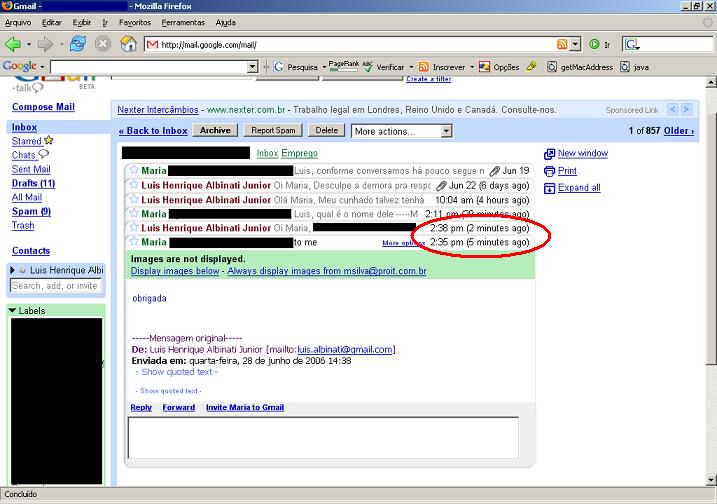
Maybe the solutions could be just take the right time. Looking for the source mail, I've percepted Gmail catches local machine time when sending, not the server one... I really believe that is not only a "Gmail Bug" (I called it a mistake), but Gmail makes it on view.
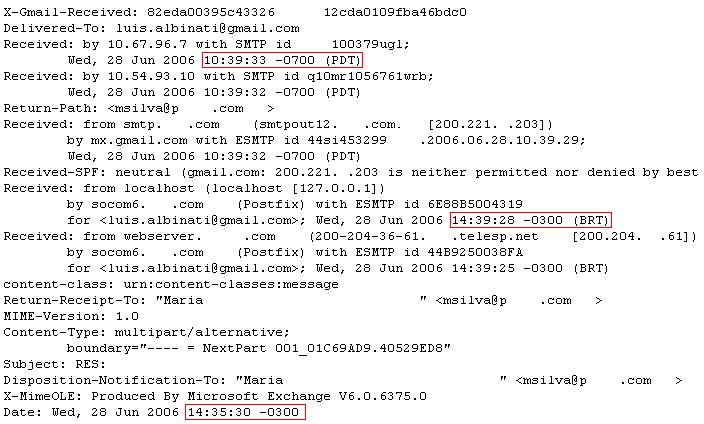
Changin' time could solve... but delay on mail servers should be more perceivable...
22 de jun. de 2006
22 de mai. de 2006
Inglaterra coberta por nuvens - Wi-Fi
Segue a onda de cidades que estão sendo cobertas por redes públicas Wi-Fi. Assim como algumas cidades nos EUA e Europa, agora também a Inglaterra está planejando uma rede cobrindo diversas cidades de uma região.
Aproveitando o encejo, aqui no Brasil, a cidade de Ouro Preto tem um projeto piloto em Wi-Max; assim como a cidade de Campinas está realizando testes nessa nova tecnologia. Wi-Max promete detonar com Wi-Fi e fazer paralelismo e concorrência com redes de telefonia. É como a evolucao da comutacao de circuitos para comutacao de pacotes; porém mudando a rede.
Wi-Max tem um alcance em torno de 50km na linha de visada, terá taxas em torno de 40Mbps (isso mesmo); e já existem versões adaptadas da Mobile-Fi que permitem handoff automático - inclusive com redes de telefonia celular 3G. Isso quer dizer que você poderá desfrutar de VoIP, navegadores, IM/Presence utilizando IP fim-a-fim e quando sair fora da rede mas estiver em uma rede 3G celular, vc nem vai perceber a mudança...
Em San Francisco, esperava encontrar Wi-Fi free em qualquer ponto da cidade. Existem, mas ainda não são sob toda a cidade. Nao vi nada também do Google sob a idéia de cobrir toda a cidade. Num dos hotéis que fiquei a conexao da internet só era possível por cabo e custava 15USD por dia - obviamente, cara demais.
JavaOne #2,#3 etc...!
Devido a correria, não deu mesmo pra continuar postando diariamente o que acontecia em San Francisco. As horas de folga que tive fui conhecer a cidade!
No stand da Siemens havia a divulgacao da plataforma da rede de servicos IMS (IP Multimedia System). No Brasil, a Siemens tem uma parceria com a Compera no desenvolvimento de solucoes IMS - SIP. Pros interessados acesse a palestra da Siemens sobre o uso IMS/SIP (JavaOne/2005).
O stand do Google mostrava as soluções mobile de search e do Google Local - uma versão do Google Maps para celulares. Nada diferente disso. O Google, no meu ponto de vista, deixa a desejar (e muito) com soluções Java. Sem contar que o stand deles não fazia frente sequer aos menores participantes desconhecidos no JavaOne.
A IBM promoveu a arquitetura SOA e suas ferramentas de desenvolvimento. Mostrou cases e número em termos de produtividade. Também estavam promovendo o desenvolvimento utilizando Eclipse e quais suas vantagens - tentando fazer uma frente ao Netbeans.
Falei com o pessoal da SMS.ac que estava bem escondidinha. Eles mostraram a ideia do negocios deles e como parece funcionar nos paises onde o envio de sms atraves das operadoras é gratuito. Questionei sobre o abuso nos "spams" - convidando voce atraves de seus contatos - e eles disseram que (claro) isso nao interferia na liberdade do usuario em bloquear estes avisos... Algum merge com Orkut ou outra rede de relacionamentos? Eles informaram que nao.
Colocarei mais relatos e as fotos em breve!
16 de mai. de 2006
JavaOne #1 day
Como eu nao tenho acesso as conferencias (ganhei o Pavilon Access do Forum Nokia Champion) eu visitei hoje alguns stands no Pavilhao. Vamos la:
Conversei com Eran Davidov - Engineering Manager, Java Test Suite - sobre Fragmentacao ME. A questao era, o que a Sun e desenvolvedores esperam melhorar no quesito fragmentacao das aplicacoes. Eric me mostrou algumas solucoes que a Sun esta oferecendo para as empresas como Nokia, Motorola, etc. com o intuito de testar e promover a correcao de bugs das implementacoes das APIs. Tambem mostrou o lado do desenvolvedor e assegurou-me quanto a "no taxes" e "free".
Conversei com o pessoal do MSA (nao lembro os nomes!) - Mobile Service Architecture. E eles mostraram um prototipo da Texas Instrument rodando aplicacoes multi-thread em Java. Era bastante rapida. No entanto ainda esta em teste.
Conheci Erik Wood - ele e o lider da documentacao MIDP - conversamos sobre aplicacoes MIDP multi-thread; uma instancia da VM abrindo varias "mini-instancias" de aplicacoes. Muito interessante, mas tenho minhas duvidas quanto a performance (vide MSA). Erik e um fa do Brasil e manja bastante de futebol!!
Conversei com o pessoal da BEA mais com o Daniel Brookshier. Ele e um entusiasta do software livre dentro da BEA. A BEA tem um portal pra desenvolvedores colocarem seus projetos e compartilhar codigos. Tambem tem espaco pra colocar seu proprio blog. Interessante que eles estao abertos pra projetos ME e nao tem NENHUM ainda nesse projeto. Seria interessante ver brasileiros ME la!
Pra quem se interessa sobre o mercado MOBILE, ouvi de algumas empresas aqui - que vendem video-streaming e jogos - sobre VIVO e CLARO. Eles estao comprando dessas empresas. Minha pergunta eh: porque nao compram de empresas brasileiras? Nao tem??? (Duvido)
Por hoje eh soh!! ;)
First Sight
Ok. Nao tive como postar antes por motivos de falta de notebook e taxas carissimas pra acesso do hotel! Alem do mais, fui conhecer a cidade ;)
Depois de 14 horas de voo, 4 horas de fuso horario diferentes, atraso na alfandega (que me fez perder meu voo de conexao - mas resolvido a tempo) eu cheguei em San Francisco!
Fui na Golden Gate, Marina's Green, Fort Mason, Fishermans Wharf e tudo mais da Bay Area. Muito legal!
Forum Nokia Champion Day
Awesome! Conheci meus companheiros de programa e assisti algumas palestras sobre as inovacoes Nokia e discutimos sobre o programa. Na parte da manha vi apresentacoes sobre o Carbide e suas integracoes com o Netbeans e o Eclipse. Perguntei sobre debug em real-devices; sobre a evolucao dos emuladores e etc. Interessante saber que o codigo fonte dos emuladores nao sao o mesmo dos real-devices... o que explica algumas incompatibilidades.
Vi tambem apresentacoes sobre o futuro so SVG (Scalable Vector Graphics) e achei muito interessante... apesar de ainda ter duvidas se as versoes lite do flash nao vao superar. De qualquer modo, eh muito simples usar (XML) - principalmente uteis com mapas atualizados em tempo real.
Sobre a documentacao Nokia, fomos questionados sobre sua utilizacao, o que esta faltando ou deixando a desejar. E foi um concenso quanto a particularidade de "achar" o que precisa. Alem disso, surgiram ideias para criar pacotes de documentos e tutoriais para estudantese iniciantes.
Apos tudo isso, teve uma integracao "THE GO GAME" - uma jogo onde as dicas estao espalhadas pela cidade de San Francisco (claro que foi pertinho do hotel) e fizemos videos, fotos, logo vou poder disponibilizar! Ahh e minha equipe ganhou :D
Na parte da noite, no jantar no restaurante "BACAR", tivemos a oportunidade de trocar mais ideias e trocar cartoes de visita.
JAVA ONE - PRIMEIRO DIA
Sobre o JavaOne ate agora estou achando muito legal! Acabei de visitar o stand da Nokia e BenQ. Quem esta patrocinando mesmo aqui no lado mobile e a MOTOROLA. Daqui a pouco estarei visitando outros stands em busca de novidades na area de mobilidade e conectividade. As fotos eu irei postar em algum outro site assim que tiver como baixa-las para algum computador que nao seje publico!
Encontrei com o Bruno Souza e o Vinicius Senger no NetBeansDay (que estava acontecendo ao lado do Nokia Champion Day); mas ainda nao vi mais brasileiros...
See!
9 de mai. de 2006
Next Step: San Francisco!

Whoa! I'm pretty excited goin' to San Fran next 12th day (I also have to get my visa stamp under USA consulate, but I imagine that's ok).
What will be happin' in SF?
- Forum Nokia Champion Day (Private - 15th)
- JavaOne Conference (16th)
- CODE MOTO (16-17th)
- NetBeansDay (15th)
- A Sun conference for certified professionals (17th)
Unfortunatelly I'll not be going to NetBeansDay 'cause the Nokia event is in the same time...
What I expect to see in SF?
- New technologies and lot of applications
- Nokia issues for mobile in Nokia Champion, meet my colleagues in Nokia Champion prg.
- Golden Gate, Alcatraz, China Town, and more!
- Brazilians group (I'll be looking for people dressin' world cup t-shirts ;)
- To meet, meet and meet people! I expect to back full of visitor cards.
I'm also will be refering these highlights.
Anything else? I'm open hearing suggestion for places and other events! :D
I'll also try to post all that here! (English or Portuguese?)
Laters!


11 de abr. de 2006
Waiting my t-shirt :D
You may have already heard about the new NetBeans 5.0 t-shirts that have started to circulate and here is your chance to win one!
--
From:
http://www.netbeans.org/community/news/index.html#814
Match the glyph representing the number five with the corresponding language and you will win a free NetBeans 5.0 glyph t-shirt. The competition will run every week from Monday - Sunday.
For more information on the concept behind the NetBeans Glyphs and to enter the weekly competition visit:
Week 1 Winners: Luis Henrique Albinati Jr. (Brazil), Ramon Omar Mata Rodriguez (Mexico), Sergey Belov (Russia), Khaja Mohammad (India), and Jaroslaw Meller (Poland)Week 2 Winners: Riteshe (Mozambique), Nathan Smith (USA), Petr Vlcek (Czech Republic), Claudiu Bulcu (Romania), and Reena Tapsee (Mauritius)
--
From:
http://www.netbeans.org/community/news/index.html#814
7 de abr. de 2006
1 de abr. de 2006
Comentários habilitados!
Os comentários estavam desabilitados e eu não conseguia alterar meu blog pelo trabalho... desculpas a parte, o blog agora esta aberto a comentários ;)
PS: o título desse post era -> (comment)Enabled(/comment) (substitua "()" por "<>". Mas acabei de perceber que o blogger processa isso como uma tag MESMO :S
PS: o título desse post era -> (comment)Enabled(/comment) (substitua "()" por "<>". Mas acabei de perceber que o blogger processa isso como uma tag MESMO :S
29 de mar. de 2006
Improving Bluetooth...
Always talking about Bluetooth I hear: "Its going to die...", "Zibee if fast and better, ...". The fact is: Bluetooth became in a market pattern. Zibee is becoming a pattern for industrial, but when talking about digital home or everything doing wireless connectivity of voice, data and video - think Bluetooth. It's still in 1.2 version, and promises to improve better rates keeping compatibility. Recently, some companies from SIG (Special Interest Group) such as Microsoft, Intel and Nokia, had adopted Bluetooth for video transmission, demanding rates of a minimum at 10Mbps.
BBC News:
http://news.bbc.co.uk/1/hi/technology/4856392.stm
BBC News:
http://news.bbc.co.uk/1/hi/technology/4856392.stm
22 de mar. de 2006
Covering stuff
20q - An artificial intelligence system that learn and try to discover what you think... Nice->
http://www.20q.net/
Anina.net - Top model and mobile specialist!? Interesting profile. She's a Forum Nokia Champion member ->
http://forum.nokia.com/main/0,,50_300_32,00.html
EQO - Skype for mobile. I didn't liked too much the sollution yet... but... ->
http://www.eqo.com/
J2ME polish - Nice stuff about devices covering Java APIs ->
http://www.j2mepolish.org/
Cheers
Assinar:
Postagens (Atom)